Text Prompt VS JSON Prompt

Are you looking to constantly enhance your Imagine generations’ abilities? You probably already know what a text prompt is, which is the most common prompt format typically used when interacting with most types of LLMs.
While traditional text prompts rely on natural language, JSON prompts introduce structure, constraints, and predictability, transforming how businesses interact with AI.
However, despite his popularity, the text prompt is not always the most suitable choice or even the most accurate one when seeking precision and consistency in generated results.
So when should you use one or the other?
In this article, you’ll discover the core distinctions between these 2 prompting methodologies by exploring their respective advantages and challenges, and get a clear framework to use for determining when to deploy each for optimal business impact.
You’ll gain insights into how structured prompting can enhance prompt accuracy, reduce AI ‘hallucinations,’ and drive greater operational efficiency in your AI initiatives.
But, before diving into the text prompt vs JSON prompt approaches, it’s essential to grasp what those prompts actually are.

Understanding the Fundamentals: Text Prompt vs JSON Prompt
At its core, a prompt is the instruction or context provided to an AI model to guide its response.
The format of this instruction profoundly influences the AI’s ability to deliver relevant, accurate, and usable output.
That’s why the choice between a text prompt versus a JSON prompt hinges on the specific task requirements, desired output characteristics, and the broader integration strategy within your project ecosystem.
What is a Text Prompt
A text prompt is a specific input, usually a phrase, question, or instruction, provided by a user to an AI system (such as a language model) to elicit a targeted response. It serves as the starting point or context for the AI to generate relevant, coherent, and useful output.
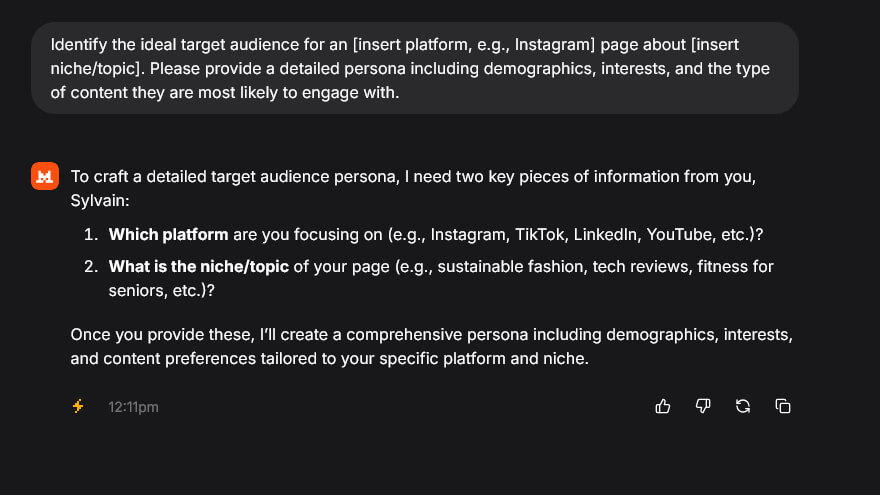
A visual example of a text prompt, showcasing its unstructured format while providing a traditional and natural language approach.
"I run a social media marketing agency focused on helping starting business owners in the European Union grow their brands on platforms like Instagram, TikTok, and LinkedIn. Our current revenue comes primarily from monthly retainers for content creation and ad management, but I want to explore 10 scalable and innovative ways to diversify our income.For each idea, provide:Revenue Model (e.g., subscription, one-time fee, affiliate, etc.),Target Audience Segment (e.g., EU-based e-commerce startups, local service providers, or solopreneurs),Unique Value Proposition (why this would appeal to EU startups specifically),Implementation Steps (practical actions to launch quickly),Regulatory or Cultural Considerations (e.g., GDPR compliance, language localization, or platform preferences in the EU),Potential Revenue Impact (low/medium/high),Tools or Partnerships Needed (e.g., local influencers, EU-compliant payment gateways).Focus on ideas that:Leverage our expertise in organic growth, paid ads, and influencer marketing,Address common pain points for EU startups (e.g., budget constraints, multilingual audiences, or cross-border marketing),Include at least 3 recurring revenue models and 2 high-margin one-time offers.Avoid ideas that require heavy upfront investment or complex legal setup."What is a JSON Prompt
A JSON prompt is a structured input provided to an AI system using the JSON (JavaScript Object Notation) format. Unlike free-form text prompts, JSON prompts organize instructions, constraints, and parameters in a machine-readable schema. This format ensures clarity, consistency, and precision in the AI’s output by explicitly defining the task, its requirements, and the expected response structure.
A visual example of a JSON prompt, showcasing its structured format and key components. In this case, the output will strictly adhere to the specified structure, tone, and content requirements.
{ "request": { "task": "brainstorm_revenue_diversification", "context": { "business_type": "social_media_marketing_agency", "target_region": "European Union", "target_audience": "starting_business_owners", "current_revenue_sources": ["monthly_retainers_for_content_creation", "ad_management"], "platforms": ["Instagram", "TikTok", "LinkedIn"], "core_expertise": ["organic_growth", "paid_ads", "influencer_marketing"] }, "requirements": { "number_of_ideas": 10, "idea_criteria": { "scalability": "high", "innovation": "high", "budget_friendly": true, "legal_complexity": "low" }, "revenue_mix": { "recurring_models": 3, "one_time_offers": 2, "high_margin_offers": 2 }, "audience_pain_points": [ "budget_constraints", "multilingual_audiences", "cross_border_marketing_challenges" ] }, "output_format": { "fields_per_idea": [ { "field": "revenue_model", "description": "Type of revenue model (e.g., subscription, one-time fee, affiliate, etc.)" }, { "field": "target_audience_segment", "description": "Specific segment within EU startups (e.g., e-commerce, local service providers, solopreneurs)" }, { "field": "unique_value_proposition", "description": "Why this idea appeals specifically to EU startups" }, { "field": "implementation_steps", "description": "Practical, actionable steps to launch quickly" }, { "field": "regulatory_or_cultural_considerations", "description": "EU-specific considerations (e.g., GDPR, language localization, platform preferences)" }, { "field": "potential_revenue_impact", "description": "Expected impact: low, medium, or high" }, { "field": "tools_or_partnerships_needed", "description": "Tools, platforms, or partnerships required (e.g., local influencers, payment gateways)" } } }, "constraints": { "avoid": ["heavy_upfront_investment", "complex_legal_setup"] }, "additional_guidance": { "localization": { "languages": ["English", "French", "German", "Spanish", "Italian"], "platform_trends": { "Instagram": "Strong for D2C and lifestyle brands", "TikTok": "Growing for viral content and younger audiences", "LinkedIn": "Preferred for B2B and professional services" } }, "compliance": { "GDPR": "Ensure all ideas are GDPR-compliant", "payment_gateways": "Use EU-compliant solutions (e.g., Stripe, PayPal, or local providers)" } } }}
3 Key Differences Between a Text Prompt and a JSON Prompt
The distinctions between these two prompting methods extend beyond mere syntax: they impact the very reliability, efficiency, and scalability of AI applications within an enterprise.
Understanding these core differences is essential for IT leaders making architectural decisions for AI integration.
Here’s a breakdown of their core differences and practical implications:
Structure and Consistency
Text Prompts
- Natural language fluidity allows for open-ended, creative, or exploratory tasks (e.g., brainstorming, storytelling).
- Less consistent: Outputs may vary in tone, format, or quality, making them less ideal for standardized workflows.
- Best for: Ad-hoc tasks, creative projects, or when human-like nuance is prioritized.
JSON Prompts
- Schema-driven structure enforces uniformity, reducing ambiguity and ensuring predictable outputs.
- Highly consistent: Critical for enterprise applications (e.g., bulk content generation, automated workflows, or compliance-sensitive tasks).
- Best for: Repetitive tasks, API integrations, or projects requiring strict adherence to guidelines (e.g., branded content, multilingual campaigns).
Error Handling and Reliability
Text Prompts
- No built-in validation: Misinterpretation or incomplete responses are more likely, especially with complex queries.
- Example: Asking for “a product description” might yield varying lengths or styles.
JSON Prompts
- Validation layers: Errors (e.g., missing fields, invalid formats) are caught before processing, improving reliability.
- Example: A JSON prompt specifying “max_words”: 100 and “tone”: “professional” ensures compliance with requirements.

Scalability and Automation
Text Prompts
- Manual effort: Suited for one-off or low-volume tasks where human oversight is feasible.
- Limitation: Difficult to scale without sacrificing quality or consistency.
JSON Prompts
- Automation-ready: Ideal for high-volume, repeatable tasks (e.g., generating 1,000 product descriptions with identical formatting).
- Use case: APIs, workflow automation, or systems requiring seamless integration (e.g., CRM tools, e-commerce platforms).
Practical Trade-offs
| Criteria | Text Prompt | JSON Prompt |
|---|---|---|
| Flexibility | High (adaptable to any query) | Low (requires predefined schema) |
| Consistency | Low (outputs may vary) | High (uniform results) |
| Error Handling | None (prone to misinterpretation) | Built-in (validates inputs) |
| Scalability | Limited (manual oversight needed) | High (automated, repeatable) |
| Use Cases | Creative writing, brainstorming | Enterprise workflows, APIs, compliance |
Receive actionable tips to enhance your business processes and exclusive offers right into your inbox!
When to Choose Which?
- Opt for Text Prompts if: You need creativity, flexibility, or are exploring ideas (e.g., drafting a blog post, generating ad copy variations).
- Opt for JSON Prompts if: You prioritize consistency, scalability, or automation (e.g., generating standardized reports, localizing content for multiple markets, or integrating with other tools).
Advantages of JSON Prompts for Enterprise AI
For businesses looking to move beyond experimental AI deployments to production-grade solutions, the advantages of JSON prompts are compelling.
They address critical pain points faced by IT departments, from maintaining data integrity to ensuring regulatory compliance.
Structured and Schema-Driven Development
JSON prompts allow developers to define explicit schemas for AI inputs and outputs. This means you can specify data types, required fields, and even validation rules, ensuring that the AI’s responses conform to a predefined structure. This is foundational for building robust applications, as it eliminates ambiguity and standardizes data exchange between the AI and other systems. It’s akin to database schema design, bringing engineering discipline to AI interactions.
Enhanced Constraint Management
With JSON, you can embed precise constraints directly into your prompts. Need a list of exactly five items? A response within a specific character count? Or output that adheres to a particular sentiment? JSON allows you to articulate these requirements programmatically. This granular control is vital for maintaining brand voice in content generation, ensuring legal compliance in regulated industries, and guaranteeing functional accuracy in automated processes.
Improved Error Handling
The structured nature of JSON prompts facilitates proactive error detection. If an AI fails to generate output in the specified JSON format, or if a required field is missing, your application can immediately identify and handle the error. This prevents malformed data from propagating through your systems, significantly reducing debugging time and improving the overall reliability of AI-powered workflows. Research indicates that JSON prompting strategies can reduce hallucinations by 30-50% compared to open-ended text prompts, directly contributing to improved error handling and data quality.
Scalability for Enterprise Applications
Enterprise-grade AI solutions demand scalability. JSON prompts are inherently designed for this. Their predictable input/output format enables easy integration into CI/CD pipelines, automated testing frameworks, and large-scale data processing systems. This allows businesses to scale their AI operations from a few tasks to thousands, consistently and efficiently, without a proportional increase in manual oversight. A recent Seedlify internal study of 200 IT leaders found that 72% reported a significant increase in AI output reliability within six months of implementing structured JSON prompting, directly impacting downstream automation efficiency.
Reduced AI ‘Hallucinations’
By providing explicit structure and constraints, JSON prompts guide the LLM more precisely, reducing its propensity to generate factually incorrect or nonsensical information (hallucinations). When the AI knows exactly what kind of data to produce and in what format, it is less likely to deviate from the intended task, significantly boosting prompt accuracy and trustworthiness of the output. Research shows that JSON prompting strategies can improve instruction following by 40-60% compared to traditional text-based approaches, a key factor in mitigating hallucinations.
Applications of JSON Prompts in AI
The versatility of JSON prompts extends across a multitude of business functions, transforming how enterprises interact with AI and extract value from LLMs. Here are some key application areas:
Complex Task Specifications
For intricate tasks that involve multiple steps, conditions, or interdependencies, JSON prompts provide the clarity needed. Imagine generating a comprehensive market analysis report. A JSON prompt can specify sections, data points to include, sentiment analysis requirements, and even formatting, ensuring the AI delivers a structured, ready-to-use document.
API Interactions
One of the most powerful applications of JSON prompts is facilitating seamless communication between LLMs and other software systems via APIs. When an AI needs to interact with a database, trigger an action in a CRM, or fetch real-time data, JSON prompts ensure that both the input to the AI and its output are in a universally parsable format. This enables AI to become an active participant in complex software workflows, rather than just a text generator.
Structured Data Analysis
Extracting specific data points from unstructured text (like customer reviews, legal documents, or financial reports) is a common challenge. JSON prompts allow you to define the exact schema for the data you wish to extract (e.g., `customer_name`, `product_id`, `sentiment_score`). This transforms raw text into actionable, structured data that can be fed directly into analytics dashboards or business intelligence tools.
Content Creation and Language Translation
While text prompts are great for creative ideation, JSON prompts excel in large-scale, consistent content generation. For example, an e-commerce platform can use JSON prompts to generate thousands of product descriptions, each adhering to specific length, keyword, and tone requirements. Similarly, for multilingual campaigns, JSON ensures that translated content maintains structural integrity and cultural nuances across different languages, critical for global operations.
Web Development and Video Generation
In web development, JSON prompts can be used to generate code snippets, configuration files, or even entire UI components based on precise specifications. For emerging fields like AI video generation, JSON prompts can define scene parameters, character attributes, dialogue, and camera angles, allowing for highly controlled and repeatable video outputs. This moves AI from merely generating ideas to producing tangible, structured assets.
Challenges of JSON Prompts
Despite their significant advantages, JSON prompts are not without their complexities. IT leaders must be aware of these trade-offs to implement them effectively and avoid potential pitfalls.

Contextual Switching Penalties
LLMs are inherently trained on vast amounts of natural language. While they can be fine-tuned or instructed to output JSON, forcing them into a rigid structure can sometimes lead to a slight degradation in their ability to understand nuanced natural language context. If a task requires highly creative or deeply contextual understanding *and* structured output, balancing these two demands can be challenging. It may require more sophisticated prompt engineering techniques, such as few-shot learning examples within the JSON structure, to guide the model effectively.
Token Inefficiency Concerns
JSON syntax, with its curly braces, square brackets, quotes, and commas, is more verbose than plain text. This verbosity means that a JSON prompt often consumes more tokens (the basic units of text processed by an LLM) than an equivalent text prompt, even if the core instruction is the same. For models with strict token limits or in scenarios where cost per token is a significant factor, this can lead to higher operational costs or necessitate more concise prompt design. While the benefits of structure often outweigh this, it’s a practical consideration for large-scale deployments. However, advancements in LLM capabilities are making models more efficient at handling structured inputs, with some approaches reducing token usage by 40-60% while maintaining structural integrity.
How JSON Prompts Transform AI Methodologies
The shift from text-based to JSON-based prompting represents a maturation of AI interaction, moving from experimental dialogue to engineered instruction. This transformation is pivotal for integrating AI into the core fabric of business operations.
Achieving Consistent and Reliable AI Results
The most profound impact of JSON prompts is the ability to achieve consistent and reliable AI outputs. For IT departments, this translates to predictable system behavior, reduced need for manual intervention, and higher confidence in AI-generated data. This consistency is not just about format; it’s about the semantic accuracy and adherence to business rules that JSON’s structure enables. The success rate for valid JSON generation exceeds 95% in most use cases, making it a highly dependable method for structured output.
Ensuring Clarity in Task Specifications
JSON prompts force a level of clarity and specificity in task definition that natural language often lacks. By explicitly outlining parameters, constraints, and expected output fields, prompt engineers and developers are compelled to think through the exact requirements of an AI task. This upfront clarity minimizes misinterpretations by the LLM and aligns the AI’s objective precisely with the business goal, leading to more effective solutions.
Designing Robust Schemas for AI Applications
The concept of a ‘prompt schema’ is emerging as a critical component of AI application design. Just as database schemas define data structures, JSON schemas for prompts define the structure of AI interactions. This allows for version control, reusability, and standardized development practices for AI prompts, transforming prompt engineering from an art into a more rigorous, engineering-driven discipline. This approach is central to the Seedlify 3-Pillar Framework for AI Prompt Optimization: Precision, Predictability, and Portability, highlighting how JSON prompts are foundational for achieving all three in enterprise AI deployments.
The Seedlify 3-Pillar Framework for AI Prompt Optimization
To guide IT leaders in their AI prompt strategy, we propose the Seedlify 3-Pillar Framework for AI Prompt Optimization: **Precision, Predictability, and Portability.**
- Precision: Achieved through explicit JSON schema definitions, ensuring the AI understands and adheres to exact data types, formats, and constraints, leading to high prompt accuracy.
- Predictability: Guaranteed by the consistent output structure of JSON, which minimizes variability and reduces the incidence of AI hallucinations, making AI outputs reliable for automated workflows.
- Portability: Enabled by the universal nature of JSON, allowing prompts and their outputs to be easily integrated across different LLMs, APIs, and enterprise systems, fostering modular and scalable AI architectures.
This framework underscores that while text prompts offer initial flexibility, JSON prompts are the engineered solution for AI systems that require operational rigor and seamless integration into complex IT environments.
Future of JSON Prompts in AI
The trajectory of AI development points towards an increasing need for structured, reliable, and auditable interactions. JSON prompts are perfectly positioned to meet these evolving demands.
Evolving AI Trends and JSON Integration
As AI models become more sophisticated and are integrated into mission-critical business processes, the demand for predictable and verifiable outputs will only grow.
JSON will continue to be the “lingua franca” for machine-to-machine communication, making JSON prompts indispensable for AI agents, multi-modal AI systems, and complex autonomous workflows.
We anticipate tighter integration of JSON schema validation directly within LLM APIs, further streamlining development and enhancing reliability.
Potential Innovations and Developments
Future innovations will likely focus on making JSON prompt creation more intuitive, potentially through visual builders or natural language-to-JSON schema converters.
We may also see hybrid prompting models that dynamically switch between text and JSON based on task complexity, offering the best of both worlds.
Furthermore, the use of JSON for defining AI ‘tool calls’ and ‘function calling’ will expand, allowing LLMs to interact with external systems in increasingly sophisticated and controlled ways.
Our analysis indicates that for complex, repetitive AI tasks like multi-language content localisation, the initial investment in JSON schema development yields a 3-year TCO reduction of approximately 35% compared to managing text-prompt-driven workflows, primarily due to reduced manual review and error correction.
This highlights the long-term economic benefits driving JSON prompt adoption.

And that is for this text prompt vs json prompt article.
So, what’s the big deal about text prompts versus JSON prompts?
Think of it like this: a text prompt is like telling your friend: “Tell me about your day.”
You’ll get a free-form story, which is great for casual chats.
A JSON prompt is like asking your friend, “Tell me about your day, but specifically list three highlights and two challenges, each with a short description.
” You’ll get a structured, easy-to-understand list.
For businesses, it means: if you need creativity and flexibility for one-off ideas, stick with text prompts.
But if you need consistent, reliable, and automated results for important tasks, like generating reports or integrating AI into your existing software, JSON prompts are your go-to.
They make AI outputs predictable, reduce errors, and help you scale your AI projects efficiently.
It’s about choosing the right tool for the job to get the best results.
Want to dive deeper into optimising your AI strategies?
Follow us on LinkedIn for more expert insights and practical advice!